Liquid medication dosing errors present documented clinical risks across pediatric, geriatric, and critical care environments. Volumetric variance in liquid administration frequently leads to adverse drug events, especially when dealing with narrow-therapeutic-index drugs. Caregivers and medical staff often rely on inaccurate dosing tools out of habit. Dosing cups and household spoons create significant discrepancies due to user reading errors and the meniscus effect. These outdated tools contribute directly to medication waste and compromised patient safety. Modern clinical standards demand engineered precision. Transitioning to a specialized oral syringe solves this core problem. Procurement teams and clinical managers must evaluate specific design features to ensure accuracy. Material safety, regulatory compliance, and tip geometry dictate operational efficiency. Selecting the right dosing instrument prevents catastrophic errors, standardizes liquid delivery across all patient populations, and ensures the exact prescribed volume reaches the patient every single time.
Key Takeaways
Precision Over Approximation: An oral medication syringe eliminates the 15-40% volumetric variance commonly seen with dosing cups by utilizing precise barrel graduations and controlled plunger mechanics.
Application-Specific Selection: Procurement decisions must differentiate between standard medication delivery, high-volume irrigation syringes, and specialized dental consumables to match clinical requirements.
Risk Mitigation via Design: Modern syringe selection requires evaluating tip compatibility (e.g., ENFit standards) and closed-system drawing accessories to prevent catastrophic tubing misconnections and ensure zero dead-space dosing.
The Mechanics of Dosing Precision: Framing the Clinical Problem
Volumetric Variance in Traditional Dosing Methods
Traditional dosing cups and spoons exhibit high statistical failure rates in clinical settings. The meniscus effect causes severe reading errors. Liquid curves at the surface inside a wide cup. Users frequently read the top of this curve rather than the bottom. This visual misalignment results in significant over-dosing or under-dosing. Household spoons vary wildly in actual volume. A standard teaspoon can hold anywhere from 3mL to 7mL.
Clinical success criteria for liquid dosing require exact volumetric delivery. The process must offer strict repeatability across different users. One nurse must draw the exact same volume as another nurse using the same tool. Complete expulsion of viscous liquids is also mandatory. Thick suspensions cling to the walls of wide dosing cups. This residual liquid means the patient never receives the full prescribed dose.
To understand why traditional methods fail, we must look at the physical mechanics of liquid measurement. When a liquid is poured into a wide-brimmed container, surface tension creates a pronounced curve. Caregivers often hold the cup at an angle or view it from above, distorting the measurement line.
Common failure points of traditional dosing cups include:
Wide surface areas that amplify the meniscus effect.
Thick plastic walls that obscure the liquid level.
Printed graduation marks that easily rub off after handling.
Lack of a controlled delivery mechanism, leading to spills during administration.
The Role of the Oral Medication Syringe in Eliminating "Dead Space"
Dead space refers to the fluid remaining in the hub and tip after the plunger is fully depressed. Standard hypodermic designs trap liquid in this narrow channel. This trapped volume alters the actual delivered dose. When administering highly concentrated medications, even a fraction of a milliliter matters. Narrow-therapeutic-index drugs require absolute precision to avoid toxicity.
An engineered oral medication syringe solves the dead space problem. These devices feature flat-faced plungers. The plunger tip aligns perfectly with the internal geometry of the barrel tip. This flush contact ensures complete medication delivery. No residual liquid remains trapped in the nozzle. This design guarantees the patient receives the exact volume drawn into the barrel.
The mechanics of a zero dead-space design rely on tight manufacturing tolerances. The rubber gasket must compress slightly against the end of the barrel. This compression forces every drop of liquid out of the tip. For pediatric patients receiving doses as small as 0.5mL, eliminating a 0.1mL dead space prevents a 20% dosing error.
Optimizing Extraction with Press-in Bottle Adapters (PIBAs)
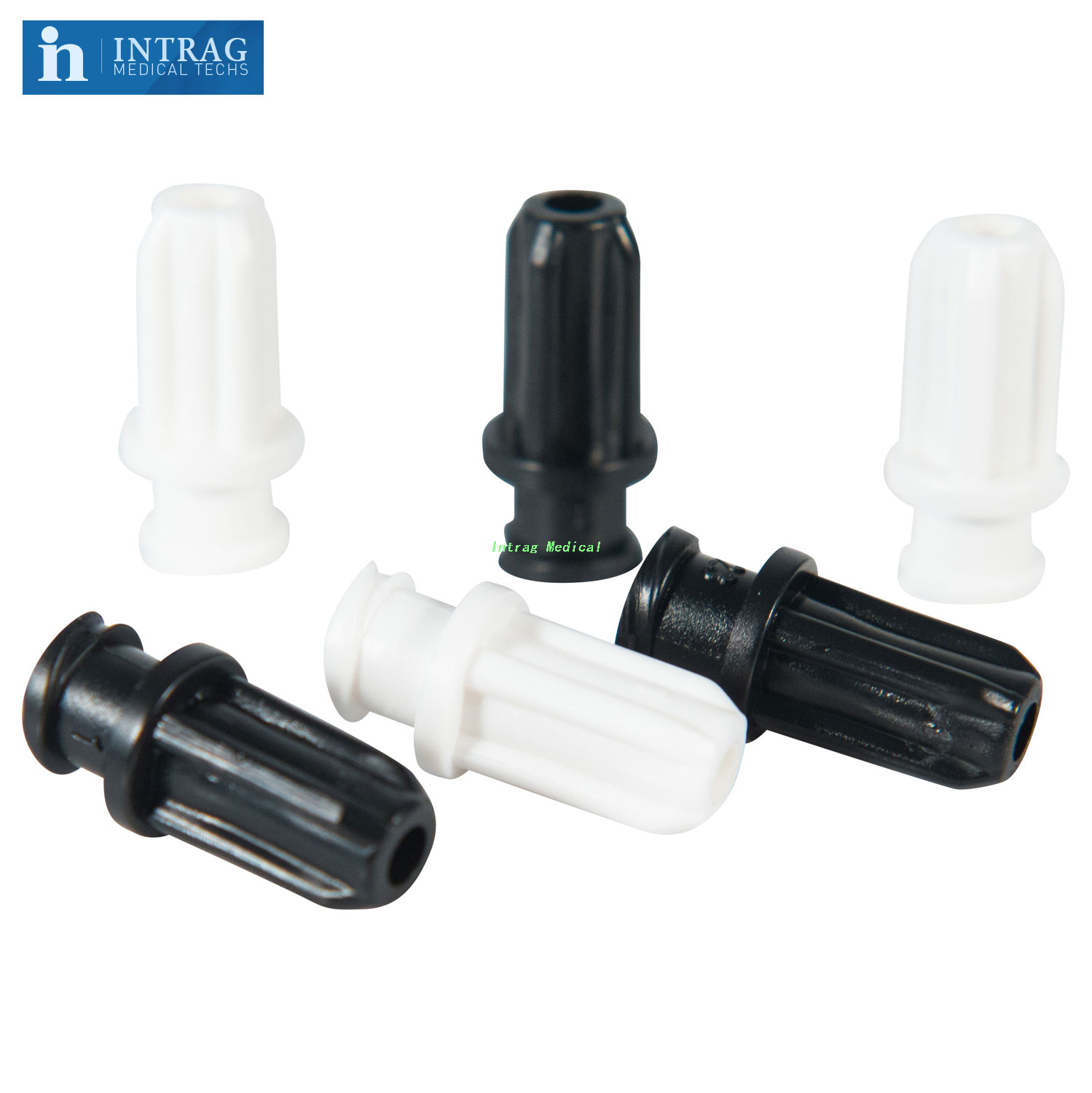
Drawing medication directly from a bottle often introduces air bubbles. Air bubbles displace liquid and ruin volumetric accuracy. Press-in Bottle Adapters (PIBAs) create a secure closed system for drawing up liquids. These stepped adapters fit snugly into the neck of the medication bottle. The syringe tip inserts directly into the adapter.
Pairing the syringe with the correct adapter prevents accidental spills. Caregivers can invert the bottle completely. Inverting the bottle allows gravity to assist the draw. This technique reduces air bubble aspiration significantly. It ensures exact volumetric extraction regardless of liquid viscosity. Thick syrups and thin solutions draw equally well through a closed PIBA system.
Implementing a PIBA system requires a specific workflow to guarantee accuracy:
Remove the original cap from the liquid medication bottle.
Insert the appropriately sized PIBA firmly into the bottle neck until flush.
Push the syringe tip securely into the adapter opening.
Invert the entire assembly so the liquid covers the adapter opening.
Pull the plunger back slowly to the prescribed volume mark.
Return the bottle to an upright position before removing the syringe.
Solution Categories: Types of Syringes and Clinical Applications
Standard Oral Medication Syringes (Pediatrics and Geriatrics)
Standard oral models range from 1mL to 10mL capacities. These sizes accommodate the vast majority of pediatric and geriatric liquid suspensions. The 1mL and 3mL sizes serve neonatal and infant dosing requirements. The 5mL and 10mL sizes handle larger antibiotic suspensions and pain management liquids for older patients.
Clear, indelible scale markings are an absolute necessity. Graduations must display in milliliters (mL) to align with modern prescribing standards. Removing teaspoon (tsp) markings prevents caregiver confusion. Dual-scale markings often lead to dangerous conversion errors. High-contrast black ink on a clear barrel provides the best visibility under harsh clinical lighting.
The physical dimensions of the barrel also matter. A wider barrel on a 10mL model requires more thumb pressure to depress the plunger. A narrower barrel on a 1mL model allows for fine motor control. This control is necessary when dispensing potent cardiac or anti-seizure medications drop by drop into an infant's mouth.
Irrigation Syringes and Dental Consumables
Clinical environments also require high-volume fluid delivery. An irrigation syringe typically holds between 10mL and 60mL. Nurses use these larger devices for wound care and surgical site cleaning. They are also essential for flushing enteral feeding tubes. The larger barrel generates the necessary pressure to clear tube blockages safely.
These devices also function as essential dental consumables. Dental professionals rely on them for post-extraction irrigation. Specialized dental models feature curved tip designs. The curved tip allows easy access to deep periodontal pockets. Patients use them at home to flush food debris from wisdom tooth extraction sites.
The flow dynamics of an irrigation model differ from a standard medication model. The tip orifice is often wider to allow rapid fluid expulsion. When flushing a wound, the clinician needs volume and velocity to dislodge necrotic tissue. When flushing a feeding tube, the wide tip ensures a secure seal against the tube port, preventing backflow and contamination.
The Single-Use Disposable Syringe vs. Reusable Models
Infection control remains a top priority in all healthcare settings. A disposable syringe offers unmatched safety advantages. Single-use devices eliminate the risk of cross-contamination between patients. Reusable models require rigorous sterilization protocols. Improper cleaning leaves microscopic drug residue and bacterial biofilms inside the barrel.
Clinical guidelines mandate single-use devices in multi-patient facilities. Repeated washing degrades the plunger gasket. The friction coefficient changes, making the plunger difficult to push. Harsh detergents also wash away the graduation marks. Faded markings lead directly to dosing errors. Single-use protocols guarantee a sterile, perfectly functioning device for every single dose.
The structural integrity of medical-grade plastics is designed for a single cycle of use. Exposure to hot water and chemical disinfectants causes the polypropylene barrel to warp microscopically. This warping breaks the airtight seal between the gasket and the barrel wall. Once that seal is compromised, the device can no longer draw liquid accurately.
Key Evaluation Dimensions for Procurement
Barrel Clarity and Graduation Markings (ISO Standards)
Procurement teams must evaluate barrel clarity. Transparent medical-grade polypropylene allows users to spot air bubbles instantly. High-contrast graduation marks must withstand handling and liquid exposure. UV-resistant ink prevents fading during prolonged storage. The markings must remain sharp and legible throughout the device's shelf life.
Compliance with ISO standards ensures volumetric accuracy. ISO 7886 outlines strict tolerances for syringe capacity and scale intervals. Purchasing ISO-compliant devices guarantees consistent performance. Accurate labeling prevents micro-dosing errors. Long-term readability under clinical lighting protects both the patient and the administering clinician.
The printing process for graduation marks involves heat-stamping or laser-etching the ink directly into the plastic. This prevents the ink from smudging when exposed to sticky liquid medications. Clinicians rely on these lines to verify the dose before administration. If a line is missing or blurred, the entire device must be discarded.
Plunger Smoothness, Gasket Integrity, and Material Safety
The friction coefficient of the plunger dictates operational control. A smooth plunger prevents sudden spurting. Spurting causes liquid to shoot past the patient's throat, risking aspiration. Smooth operation allows for slow, controlled delivery. The caregiver can dispense the liquid drop by drop if necessary.
Material trade-offs impact gasket integrity. Latex-free synthetic rubber provides excellent chemical compatibility with most liquid medications. Silicone O-rings offer superior glide but may interact with certain oil-based suspensions. Material safety requirements are stringent. Components must be BPA-free, DEHP-free, and PVC-free. These standards meet strict pediatric and neonatal safety regulations, preventing endocrine disruption.
The design of the plunger rod also contributes to stability. Ribbed plunger rods prevent the thumb from slipping during administration. A wide thumb press area distributes the force evenly. This ergonomic design reduces hand fatigue for nurses who administer dozens of liquid doses during a single shift.
Tip Design and Connection Safety
Tip design directly impacts patient safety. The industry is shifting away from standard Luer slip tips for enteral feeding and oral dosing. Luer tips can accidentally connect to intravenous lines. Injecting oral liquids into an IV line causes fatal embolisms and sepsis. Specialized oral tips prevent this catastrophic error.
The ENFit standard (ISO 80369-3) represents the current benchmark for connection safety. ENFit connectors feature an inverted design. They physically cannot connect to Luer-based IV ports. This forced incompatibility eliminates cross-connection risks. Evaluating tip design ensures compliance with global safety mandates.
Beyond ENFit, other specialized tips serve specific functions. Catheter tips feature a long, tapered nozzle designed to fit securely inside large-bore feeding tubes. Eccentric tips are positioned off-center on the barrel, allowing the syringe to rest flat against the patient's cheek during administration. This angle prevents the liquid from hitting the back of the throat directly.
Regulatory Compliance and Supply Chain Reliability
Procuring medical devices requires strict regulatory verification. Facilities must verify FDA 510(k) clearance for all dosing devices used in the United States. CE markings indicate compliance with European health, safety, and environmental protection standards. These certifications validate the manufacturer's quality control processes.
Vendor reliability ensures uninterrupted clinical operations. Facilities need consistent stock levels. Comprehensive kitting provides significant operational advantages. Procuring syringes pre-packaged with appropriate bottle adapters saves time. It ensures the correct adapter is always available at the point of care.
Quality management systems, such as ISO 13485, dictate how manufacturers handle raw materials and assembly. Facilities should request documentation proving that the manufacturing environment meets cleanroom standards. Particulate contamination inside the barrel poses a severe risk to immunocompromised patients.
Comparison of Syringe Tip Designs and Clinical Applications
Tip Design
Primary Application
Connection Standard
Key Safety Feature
Standard Oral Tip
Pediatric liquid medication delivery
Non-Luer compatible
Prevents accidental IV injection
ENFit (ISO 80369-3)
Enteral feeding and medicating
Inverted threaded lock
Physically incompatible with IV ports
Curved Tip
Dental and wound irrigation
Tapered nozzle
Allows targeted fluid delivery in tight spaces
Catheter Tip
High-volume tube flushing
Elongated taper
Fits securely into large-bore feeding tubes
Value and Clinical Efficiency in Syringe Selection
Bulk Procurement vs. Specialized Clinical Needs
Procurement strategies often balance universal utility against specialized clinical requirements. Purchasing universal, low-cost syringes simplifies inventory management. A standard 5mL clear barrel serves most general wards. However, specialized departments require specific models. Neonatal units need 1mL sizes with hyper-accurate micro-graduations.
Balancing unit utility requires a clear framework. Amber-tinted barrels are necessary for light-sensitive drugs. Specialized dental tips are required for oral surgery recovery. Stocking application-specific models prevents clinical workarounds. Workarounds compromise patient safety. Facilities must audit departmental needs to build an efficient, targeted inventory.
Standardization committees should include frontline nursing staff. Nurses provide practical feedback on how different models perform during actual patient care. A model that looks good on a specification sheet might have a stiff plunger that makes slow administration impossible. Gathering this feedback prevents the facility from committing to a large order of unusable devices.
The Hidden Impact of Inaccurate Dosing
Poor syringe selection generates severe downstream consequences. Inaccurate dosing wastes high-value liquid medications. Spills and residual dead-space fluid deplete pharmacy budgets rapidly. Narrow-therapeutic-index drugs are particularly expensive. Wasting even small amounts compounds into massive annual losses.
Dosing errors increase institutional liability. Under-dosing delays patient recovery and extends hospital stays. Over-dosing triggers adverse drug events. Managing these adverse events requires intensive labor resources. Nurses and physicians must intervene to stabilize the patient. Proper syringe selection eliminates these hidden clinical and operational burdens.
Consider the workflow disruption caused by a leaking syringe. If the gasket fails during the draw, the nurse must discard the device, clean up the spilled medication, document the waste, and start the process over. This wastes valuable nursing time and delays medication administration for other patients on the ward.
Implementation Risks and Clinical Adoption
Mitigating Cross-Connection Risks
Transitioning to new connector standards introduces implementation risks. Staff confusion during the shift to ENFit can disrupt care. Nurses accustomed to legacy Luer slips may struggle with the new threaded connections. Muscle memory dictates workflow. Changing the physical mechanics of drawing and administering medication requires careful management.
Mitigation strategies ensure a smooth transition. Phased rollouts allow departments to adapt gradually. Temporary use of transition adapters bridges the gap between old bottles and new syringes. These adapters maintain dose accuracy while staff learn the new system. Clear communication from clinical leadership drives successful adoption.
Visual aids placed in medication rooms help reinforce the new workflow. Posters demonstrating the correct way to attach an ENFit syringe to a feeding tube port reduce hesitation. Hands-on practice sessions during shift huddles allow staff to experience the tactile difference of the new connectors before using them on a patient.
Staff Training and Protocol Standardization
Proper training protocols are essential for nursing staff, dental hygienists, and home caregivers. Staff must learn exact drawing techniques. They must understand how to read the volume at the bottom of the liquid meniscus. Holding the syringe at eye level guarantees an accurate reading. Pushing the plunger slowly prevents aspiration.
Standard operating procedures (SOPs) streamline inventory management. SOPs ensure the correct syringe type matches the clinical application. The corresponding bottle adapters must always be available at the point of care. Standardizing these protocols eliminates guesswork. It builds a culture of precision and safety across the entire healthcare facility.
Training should also cover the proper disposal of single-use devices. Even though oral models do not have needles, they still contain trace amounts of prescription medication. Facilities must establish clear guidelines on whether these devices go into standard trash, pharmaceutical waste bins, or biohazard containers based on the medication administered.
Conclusion
Transitioning to high-quality oral syringes represents a foundational requirement for clinical accuracy. Precision dosing instruments directly impact patient safety and therapeutic outcomes. Eliminating volumetric variance protects vulnerable pediatric and geriatric populations from adverse drug events. The decision matrix for procurement is clear. Prioritize ENFit-compliant models for hospital settings to eliminate cross-connection risks. Select curved-tip irrigation models for dental practices. Choose high-clarity, single-use models for general outpatient care. Matching the tool to the specific clinical application guarantees optimal performance.
To ensure immediate improvements in liquid dosing accuracy, follow these next steps:
Audit current liquid dosing failure rates and identify departments relying on outdated dosing cups.
Request detailed specification sheets from manufacturers, verifying ISO compliance and material safety data.
Initiate a clinical trial with shortlisted models to gather direct handling feedback from frontline nursing staff.
Update facility standard operating procedures to mandate the use of Press-in Bottle Adapters for all liquid draws.
FAQ
Q: What is the difference between an oral syringe and a regular hypodermic syringe?
A: Oral syringes lack a Luer lock mechanism and cannot attach to hypodermic needles. Their tips are often off-center or specifically oversized to prevent accidental connection to intravenous lines. Hypodermic syringes are designed for injections, whereas oral models are engineered exclusively for delivering liquid directly into the mouth or an enteral feeding tube.
Q: How accurate is an oral medication syringe compared to a dosing cup?
A: Oral syringes deliver extreme precision, typically accurate within 2% to 5% of the target volume. Dosing cups suffer from the meniscus effect and user reading errors, with variance frequently exceeding 20%. For narrow-therapeutic-index medications, the precision of a syringe is clinically mandatory to prevent adverse drug events.
Q: Can you reuse a disposable syringe for oral medications?
A: No. Clinical standards mandate single-use protocols. Reusing a disposable device introduces severe infection control risks. Washing degrades the internal plunger gasket, causing it to stick or spurt. Detergents also wash away the graduation marks. Single-use ensures a sterile, accurate, and fully functional device for every dose.
Q: What makes an irrigation syringe different from a standard oral syringe?
A: Irrigation models feature much larger volume capacities, typically ranging from 10mL to 60mL. They utilize specialized tip designs, such as elongated catheter tips or curved nozzles. While standard models focus on precise micro-dosing for medication, irrigation models are designed for flushing feeding tubes, cleaning wounds, and clearing surgical sites.
Q: Are dental consumables like irrigation syringes regulated differently?
A: Yes. The FDA classifies dental devices based on their specific intended use in the oral cavity. While they share manufacturing similarities with general enteral devices, dental irrigation tools must meet specific standards for post-surgical wound care. They are evaluated for their ability to safely flush periodontal pockets without damaging tissue.
Q: What is "dead space" in an oral syringe and why does it matter?
A: Dead space is the residual fluid trapped in the hub and tip after the plunger is fully depressed. Minimizing dead space ensures the patient receives the exact prescribed dose. This is vital for highly concentrated liquid medications, where even a 0.1mL discrepancy can lead to severe underdosing or toxic overdosing.
Q: Do oral syringes require special adapters to draw medication from bottles?
A: Yes. Press-in Bottle Adapters (PIBAs) are highly recommended. These adapters fit securely into the medication bottle neck. They create a closed system that allows the user to invert the bottle. This gravity-assisted method prevents spills, eliminates air bubble aspiration, and ensures a perfectly accurate draw every time.
Providing "High Quality Products, Excellent Service, Competitive Prices and Prompt Delivery", we are now looking forward to have greater and further cooperation with customers all over the world, based on mutual benefits.