Did you know a simple IV flush directly impacts patient safety and hospital overhead? In bustling clinical environments, every single second counts. Historically, nurses manually drew saline from vials. This outdated method increased contamination risks and consumed valuable labor hours. Switching to pre-filled options significantly reduces medication errors while streamlining daily workflows.
However, the medical consumable market has experienced intense volatility recently. Securing reliable inventory now requires highly strategic procurement. In this comprehensive guide, we break down the current market landscape. You will learn how to evaluate technical specifications and select the right pre-filled saline flush syringe to protect patients and optimize your supply chain.
Key Takeaways
Size Matters: Understanding fluid dynamics is crucial. Choosing the correct barrel size dictates catheter injection pressure and prevents line ruptures.
Safety & Compliance: Always verify terminal sterilization (SAL 10-6), DEHP-free materials, and regulatory compliance to prevent catheter-related bloodstream infections (CRBSIs).
Supply Chain Resilience: With ongoing FDA alerts on saline shortages, partnering with a vetted, diversified manufacturer is vital for maintaining consistent inventory.
Total Cost of Ownership (TCO): Unit price is only one factor. Evaluating reduced infection rates, fewer occluded lines, and nursing time saved provides the true measure of procurement value.
What Is a Pre-Filled Saline Flush Syringe?
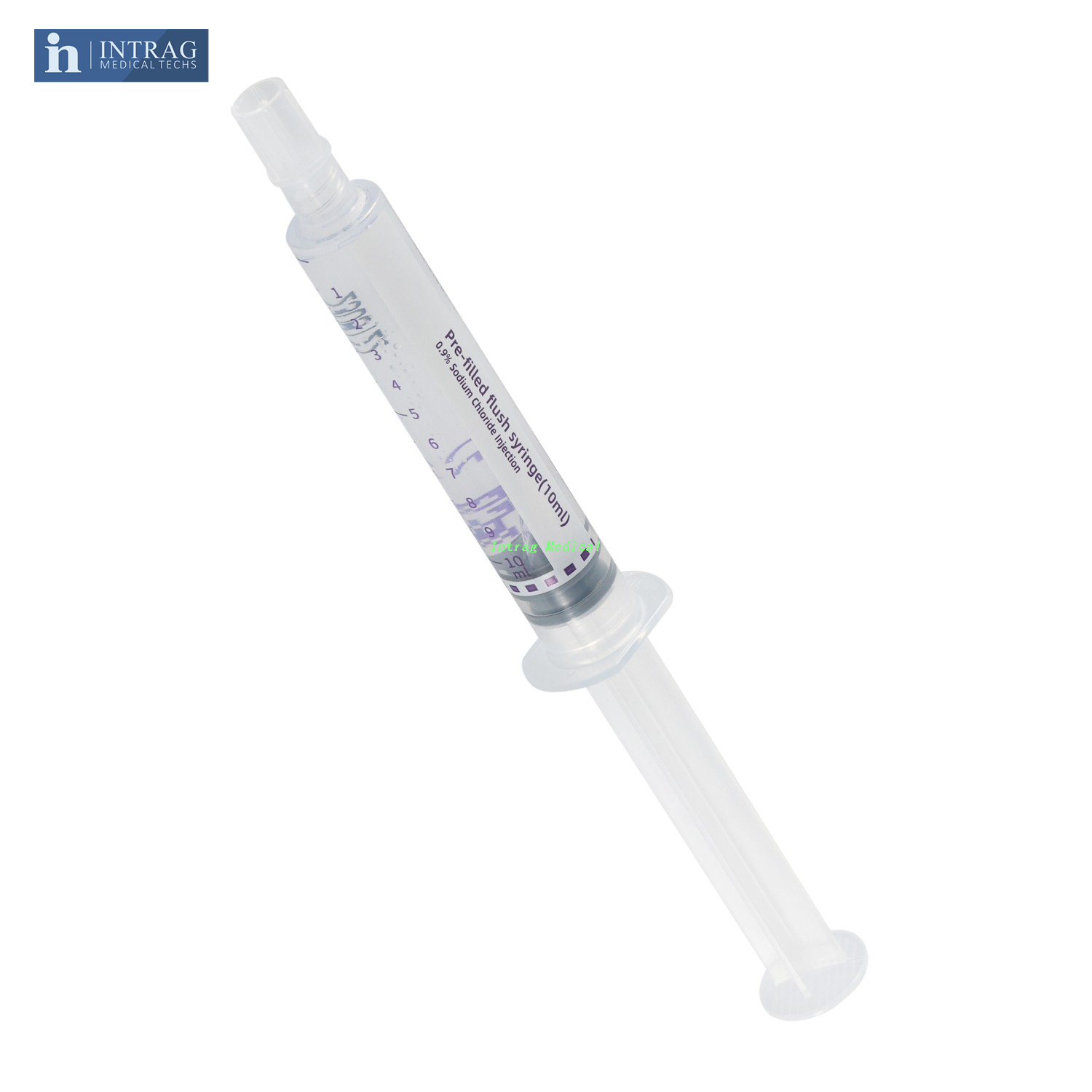
A pre-filled saline flush syringe is a ready-to-use medical device containing a sterile 0.9% sodium chloride solution. Its primary clinical job is straightforward: flush intravenous (IV) lines, maintain catheter patency, and prevent incompatible medications from mixing during sequential administration. Because the 0.9% sodium chloride solution is isotonic, it perfectly mirrors the natural salt concentration of human blood. This critical balance minimizes cellular damage and vein irritation during injection.
In the past, clinicians had to manually draw saline into an empty syringe. That traditional method involved multiple touchpoints. Each touchpoint increased the risk of bacterial contamination, needle-stick injuries, and dosage errors. Today, transitioning to a disposable flush syringe solves these exact issues. Picture a high-stress emergency department. Instead of fumbling with vials while a patient waits, a nurse simply opens a blister pack, connects the standard Luer-lock tip, and flushes the line immediately.
The clinical benefits of these pre-filled systems are undeniable. By eliminating the manual drawing process, these devices save critical nursing time. Furthermore, because they are manufactured and sealed in strictly controlled environments, they drastically reduce the risk of introducing external pathogens into a patient's bloodstream.
Understanding Syringe Sizes: 3ml, 5ml, and 10ml Options
Selecting the correct syringe volume goes far beyond measuring fluid. It is fundamentally about fluid dynamics, flush pressure, and the specific type of catheter in use. The internal diameter of the syringe barrel dictates the pressure exerted during injection. Counterintuitively, a smaller syringe barrel generates significantly higher pressure per square inch (PSI) than a larger barrel. Grasping this principle is essential for procurement officers mapping products to clinical needs.
Industry Insight: Recent market analysis shows a growing trend toward volume optimization. Hospitals are moving away from a rigid "one-size-fits-all" 10ml approach. Instead, they are adopting targeted sizing to reduce plastic waste and conserve saline supplies amidst global shortages.
The 3ml Saline Flush Syringe
The 3ml saline flush syringe is engineered specifically for highly sensitive populations. This includes pediatric, neonatal, or geriatric patients with extremely fragile veins. In these scenarios, fluid overload is a critical concern. A 3ml volume provides exactly enough sterile saline to clear the catheter tubing without introducing unnecessary fluid into the patient's circulatory system.
The 5ml Saline Flush Syringe
Serving as a highly versatile middle-ground option, the 5ml saline flush syringe is widely used for standard adult peripheral IV maintenance. From a supply chain perspective, stocking 5ml syringes is a strategic move. It conserves overall saline supplies during market shortages, ensuring that larger volumes are reserved strictly for procedures that clinically demand them.
The 10ml Saline Flush Syringe
The 10ml syringe represents the mandatory clinical standard for Central Venous Catheters (CVCs), including PICC lines. Clinical guidelines strictly dictate the use of a 10ml syringe barrel diameter for central lines. Because a 10ml barrel is wider, it generates a much lower injection pressure. High pressure from smaller syringes can actually cause central venous catheters to rupture or dislodge internal blood clots, leading to severe complications.
Syringe Size
Barrel Pressure Profile
Primary Clinical Application
Key Procurement Consideration
3ml
High PSI
Neonatal, Pediatric, Geriatric Peripheral IVs
Minimizes fluid overload in sensitive patient populations.
5ml
Moderate PSI
Standard Adult Peripheral IVs
Excellent for saline conservation and standard ward use.
10ml
Low PSI
Central Venous Catheters (PICC, CVC)
Mandatory safety requirement to prevent catheter rupture.
Safety, Sterilization, and Clinical Efficacy Standards
When evaluating pre-filled flush products, procurement teams must look beyond basic functionality. The integrity of the sterilization process and the physical material design directly impact clinical outcomes and facility liability.
Terminal Sterilization vs. Aseptic Fill
The manufacturing sterilization method is a critical evaluation metric. Aseptic filling involves sterilizing the saline and the syringe components separately, then assembling them in a sterile environment. While effective, it carries a marginal risk of contamination during assembly.
Conversely, terminal sterilization is the absolute gold standard for infection control. In this process, the syringe is fully assembled, filled, and sealed in its final packaging before being subjected to sterilization (usually via steam). This method guarantees a Sterility Assurance Level (SAL) of 10-6. It effectively neutralizes any potential pathogens, offering maximum protection against CRBSIs. Buyers should always demand documentation proving terminal sterilization protocols.
Material and Design Specifications
The physical materials and ergonomic design are equally important. To avoid severe allergic reactions and toxicity, modern flush syringes must be entirely free of DEHP, natural rubber latex, and chemical preservatives.
Specifically, a common complication in IV maintenance is "blood reflux"—where blood backs up into the catheter tip when the nurse releases the plunger. High-quality syringes feature smooth-gliding silicone-coated plungers and solid rib designs that minimize this rebound effect. Clear labeling and standardized barcoding are also non-negotiable. They prevent medication mix-ups and facilitate rapid integration into hospital electronic health records (EHR).
Navigating FDA Guidelines and Supply Chain Shortages
The medical supply chain has experienced notable volatility in recent years. Saline products frequently appear on official shortage lists. Observing recent industry shifts, healthcare networks are moving away from fragile just-in-time inventory models. Instead, they are building robust safety stocks and seeking localized or diversified manufacturing partners.
Practical Conservation Strategies
To mitigate the impact of supply bottlenecks, clinical and procurement teams must align on practical conservation strategies. Official guidelines strongly advise against using pre-filled flush systems for off-label purposes, such as diluting other medications. Additionally, hospitals must strictly match the syringe size to the clinical need. Defaulting to larger sizes wastes vital inventory meant for critical procedures.
Supply Chain Diversification
Relying on a single manufacturer for critical consumables is a high-risk gamble. Buyers are advised to diversify their supply chains by vetting secondary and tertiary suppliers. Establishing relationships with multiple qualified factories ensures that if one supplier faces a raw material delay, the facility can seamlessly pivot without compromising patient care.
How to Evaluate and Choose a Reliable Prefilled Syringe Supplier
Identifying a dependable manufacturing partner requires rigorous evaluation. When assessing a potential prefilled syringe supplier, B2B buyers must scrutinize regulatory compliance, surge capacity, and data transparency to avoid severe stockouts.
Regulatory Certifications and Quality Assurance
The baseline requirement for any medical device manufacturer is strict adherence to international standards. Procurement teams should request FDA 510(k) clearance for the US market, CE marking (MDR compliance) for Europe, and ISO 13485 certification. Furthermore, demand the SAL reports to prove their sterilization process actually achieves the 10-6 standard.
Packaging Options: Bulk vs. Sterile Blister Packs
Physical packaging directly impacts hospital storage logistics and clinical application. Individual sterile blister packs are mandatory for sterile fields, operating rooms, and central line maintenance. In contrast, bulk packaging is highly space-efficient and cost-effective for standard peripheral IV maintenance in general wards. A versatile supplier should provide both configurations.
Cost vs. Value: Evaluating the Total Cost of Ownership
In medical procurement, focusing exclusively on the lowest unit price often masks hidden downstream expenses. Utilizing a Total Cost of Ownership (TCO) model provides a much more accurate assessment of a product's true financial impact.
Unit Price vs. Hidden Clinical Costs
Consider a scenario in an intensive care unit. A cheaply manufactured syringe features a rigid plunger that sticks during administration. This uneven pressure causes blood reflux, leading to a clotted catheter. The nurse must now spend twenty minutes troubleshooting or assisting in a complete line replacement. The cost of labor, replacement supplies, and patient discomfort rapidly eclipses the pennies saved upfront. Worse yet, inadequate sterilization could trigger a CRBSI, costing a facility tens of thousands of dollars.
The Value of Nursing Efficiency
The TCO must account for workflow efficiency. High-quality pre-filled syringes feature easy-to-open packaging, distinct color-coded labels, and standard Luer-lock tips that connect seamlessly to needleless connectors. By shaving just seconds off every single IV maintenance procedure, a hospital can reclaim hundreds of hours of nursing labor annually.
Choosing the right pre-filled saline flush syringe ensures patient safety while stabilizing your facility's supply chain. Verify terminal sterilization, adhere strictly to correct sizing guidelines, and evaluate total ownership costs. If you are ready to upgrade your medical inventory with reliable, compliant products, explore the full range of injection solutions at Medintrag. Request a product sample or custom quote today to secure your supply chain.
Frequently Asked Questions (FAQ)
What is the shelf life of a pre-filled saline flush syringe?
Most commercially manufactured pre-filled saline flush syringes have a standard shelf life of 36 months from the date of production. However, this is contingent upon the product being stored correctly in a temperature-controlled environment, away from direct sunlight, extreme heat, or freezing conditions. Buyers and clinical staff should always verify the expiration date printed clearly on the syringe barrel before administration.
Can you use a 10ml saline flush syringe on a peripheral IV?
Technically yes, but it is often unnecessary and wasteful. For standard adult peripheral IV maintenance, a 5ml size provides adequate volume to clear the line. You should reserve 10ml syringes for central lines (like PICCs), where the larger 10ml barrel diameter is a mandatory clinical safety requirement to keep injection pressure low and prevent catheter rupture.
Are disposable flush syringes reusable on the same patient?
Absolutely not. Under no circumstances should a disposable flush syringe be reused, even on the same patient or the same IV line. These devices are strictly designated for single use. Once the sterile seal is broken and the syringe is attached to a catheter hub, the tip becomes contaminated. Reusing the syringe introduces a severe risk of bloodstream infections.
Why is 0.9% sodium chloride used in flush syringes?
The solution of 0.9% sodium chloride (normal saline) is used because it is isotonic to human blood plasma. It has the exact same concentration of solutes as the fluid inside human red blood cells. When injected, it does not cause fluid to shift into or out of the blood cells, preventing cellular swelling or shrinking. This makes it the most biologically compatible fluid for clearing lines without irritating veins.
Are pre-filled saline syringes DEHP and latex-free?
Yes, premium pre-filled flush syringes are manufactured using medical-grade plastics that are entirely free of DEHP (a common plasticizer) and 100% free of natural rubber latex. This strict material standard is crucial for preventing severe allergic reactions and chemical toxicity, especially in vulnerable pediatric and neonatal patients.
What is the difference between aseptic fill and terminal sterilization in flush syringes?
Aseptic filling means the saline solution and the syringe components are sterilized separately and then combined in a clean room environment. This method leaves a slight risk of contamination during assembly. Terminal sterilization means the fully assembled, filled, and packaged syringe is sterilized as a complete unit (usually via steam), providing the highest possible sterility assurance level (SAL 10-6).
Providing "High Quality Products, Excellent Service, Competitive Prices and Prompt Delivery", we are now looking forward to have greater and further cooperation with customers all over the world, based on mutual benefits.